RSS

Vancouver hotel projects planned for Marpole, downtown

The City of Vancouver has received two separate rezoning applications that propose to build a total of 523 hotel rooms in mixed-use projects planned for Marpole and downtown.

BDK Development Corp. is behind the 30-storey building at 8555 Cambie St. while Reliance Properties Ltd. and real estate investment management firm Hines have applied to build a 49-storey tower at 1166 West Pender St.

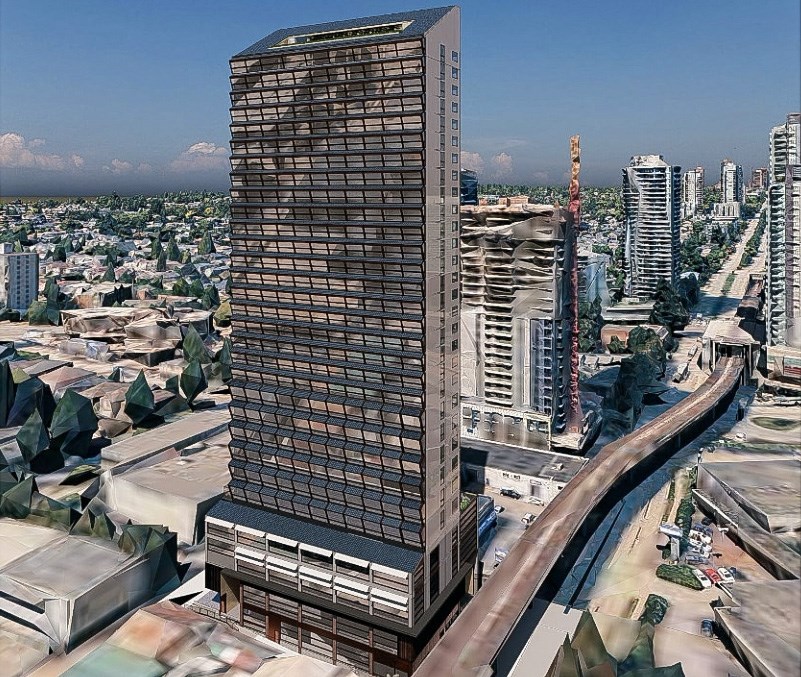
BDK’s proposal replaces a two-storey commercial building in the Marine Landing area with a tower that will accommodate 25 storeys of hotel space with 324 rooms, industrial space for a bakery, a restaurant on the 30th floor and retail shops.

“We believe that the addition of hotel, employment and industrial spaces this project delivers, as well as the photovoltaic panel designs and ground-floor public realm enhancements support livability, health and sustainability in Marine Landing,” BDK said in its application booklet.

BDK says photovoltaic panels would enable the production of renewable energy for the building, while the panels are strategically angled to provide occupants with shade in the summer and light penetration in the winter.

'Hotel space outside of downtown Vancouver'

The site is located between Southwest Marine Drive and Kent Avenue, 180 metres from the Marine Drive Canada Line station, the first stop into Vancouver from Vancouver International Airport.

“The proposal responds to the growing demand for visitor accommodation and council’s directive to increase hotel space outside of downtown Vancouver,” said BDK. The company is working with Sea to Sky Architecture and RR Planning Ltd. on the project.

The nearest accommodations to the site are an older hotel to the west at Oak and Southwest Marine Drive, as well as two short-term rentals several blocks to the north and east.

“Given the site's unique gateway location, amenity draw and growing population, the additional hotel space would benefit the community with more available jobs and more visitors to support local businesses,” BDK said.

Since the opening of the Canada Line in 2009, the area has been transforming into an urban community with a growing mix of housing, jobs and services. The change has increased traffic volumes.

The site is located to the south of several mixed-use tower sites that range from 13 to 35 storeys, with the tallest buildings adjacent to Marine Drive station.
'Market conditions' scrap original proposal

Meanwhile, the hotel proposal for 1166 West Pender St. includes 199 hotel rooms on the first 11 levels of the tower. Another 33 levels would be dedicated to 340 strata residential units, according to the Reliance-Hines application booklet.

The original scheme for the wedge-shaped site in the central business district, which received rezoning approval in 2019, was a 32-storey office tower with more than 350,000 square feet of office space.

It would have replaced a 15-storey building.

“Due to market conditions, the project is unable to proceed as previously proposed,” the developers’ application booklet said.

“The new design features a more slender tower form, greater setbacks and a smaller tower plate compared to the original office building, better integrating into the surrounding urban context while increasing the total height [to 530 feet] and program mix.”

Several new projects have recently been built in the neighbourhood.

Directly across the lane south of the proposed site is The Stack, a 33-storey, 531.5-foot office building. Further to the south is the Paradox Hotel, a 63-storey tower at 1161 West Georgia St.

Down the street to the east on 1090 West Pender St. is another recently constructed 31-storey office building. The 13-storey Loden Hotel and the 20-storey Coast Coal Harbour hotel are in the neighbourhood.

“The proposed 1166 West Pender project addresses critical gaps in Vancouver’s housing and hotel sectors while supporting long-time economic growth and aligning with city policies aimed at addressing housing needs and improving the local tourism economy,” Reliance-Hines said.

The public feedback window for people to weigh in on the project runs from Nov. 18 to Dec. 1. The question-and-answer period for the 8555 Cambie St. proposal opens Nov. 4 and runs until Nov. 17.

Participation can occur by accessing the City of Vancouver’s “Shape Your City” section of the website.

mhowell@lodestarmedia.ca

X/@Howellings

Read

Foreign investor pays $18.2M for Tsawwassen Corner Shopping Centre

Strong interest following the listing of Tsawwassen Corner Shopping Centre at 1215 56th St., Delta, last fall has culminated with the property’s sale to a foreign investor.

The transaction closed on July 8, with a final sale price of $18.2 million. This was slightly below the 2025 assessed value of $19 million.

However, lead listing agent Andrew Gormley of Marcus & Millichap’s Western Canada NNN Group said demand was strong, with the open-air mall garnering 86 signed confidentiality agreements from prospective buyers and seven letters of intent during the marketing campaign. The successful offer was unconditional, underscoring the buyer’s confidence in the asset.

Maddie Chen of Re/Max Crest Realty represented the buyer, while Gormley together with Jon Buckley, Joe Genest, Curtis Leonhardt and Armaan Sohi represented the seller.

Built in 1967 on just under two acres, the mall totals 28,010 square feet. It traded at $650 per rentable square foot and a 4.7 per cent cap rate on in-place net operating income.

“The sales price reflects strong pricing in today's market, particularly given the asset carries approximately $1.3 million in deferred capital maintenance recommended over the next decade,” Gormley said. “Multiple private and institutional bidders drove competitive pricing, confirming significant investor demand for well-located, nationally tenanted open-air retail centres in the Greater Vancouver area.”

Tsawwassen Corner's anchor tenant, Shoppers Drug Mart, has 30 years of renewal options remaining, providing long-term income stability while near-term value creation is supported by TopCut Barber’s departure on Sept. 1 that will see a new tenant secured at current market rates.

Contractual escalations across the tenant roster, including upcoming renewal opportunities for Shoppers Drug Mart, Vancity, and Liquor Quicker, support long-term value creation.

Paul Richter, director of market analytics with CoStar, noted that the asset's steady cash flow was particularly appealing, though its valuation has dropped steadily since July 1, 2024, when BC Assessment valued the mall at $20.2 million.

"The property traded for roughly 10% below its peak assessed value," Richter said. "This is another sign that investors are placing greater value on cash flow and less value on speculative redevelopment upside. The market is becoming increasingly income-driven, which is leading to a reset in pricing for many redevelopment-oriented assets."

The transaction represented the largest retail centre sale in Delta since 2022, when Trenant Park Square a much larger property, at 131,000 square feet sold for $75 million.

Read

Manufactured home parks ride affordability wave in Western Canada

Manufactured home parks are poised to benefit from affordable housing policies as the government seeks to increase the supply of affordable and pre-fabricated homes, experts told Western Investor.

“We’re always talking about housing crisis or affordability crisis, and I think modular homes fit right in to solve that issue,” said Chris Rust, senior vice-president with CBRE Ltd., who recently listed a 100-lot modular home development opportunity for $10.6 million in Chemainus, B.C.

“It’s a more efficient way to produce housing,” he said. “Manufacturers are popping up and they are all going to need a place to put these homes.”

Manufactured home parks, recovering after being hit by post-COVID interest rate hikes, are viewed as investments that can offer steady cash flow and hands-off management. With mom-and-pop owners retiring, more opportunities are coming to market and institutional players are getting in on the action.

But the parks can vary in quality and infrastructure, and are being hampered by tenant-focused policies, costly upgrades for aging assets and even public stereotypes.

“Many municipalities have a really hard time, despite this affordability push, to actually zone land ‘mobile home park.’ They’re all scared of it. They think that somehow, they’re downgrading their town or their community rather than bringing in affordability and homeownership,” said Eugen Klein of Royal LePage Westside Klein Group in Vancouver.

There are just under 900 manufactured home parks in B.C., with about 50,000 pads, compared to over 2,000 parks in Alberta and 4,000 or 5,000 in Washington State, he said. B.C. park vacancies are less volatile due to the constrained supply, but provincial policies and rent controls deter owners from making capital upgrades to B.C. parks built in the 1960s and ‘70s, Klein said.

Bill Summers of Coldwell Banker Executives Realty in White Rock, B.C., said despite this, manufactured home parks are a solid investment.

“It’s affordable housing, which is in super high demand,” he said.

Summers said vacancies are very rare in well-managed parks, ensuring stable cash flows from tenants who lease the pads and own the housing units located on them. This makes them a hands-off investment, one that Summers said can double in value within 10 years.

All owners do is supply the services to tenants’ pads and maintain common area, he said. He currently has 11 listings – “more than I’ve had in a long time” – mainly due to investors retiring and divesting.

Not all parks are made equal, however. Some have city water and sewer, while others rely on their own systems which may require hiring a water management company.

Some older parks also require electrical upgrades, Summers said.

“You’ve got to make sure the backup power’s on and pumps are working properly and tanks, [and] the purification system is good,” he said. “So there are some liabilities with that, but those are what make a park good.”

Klein said cap rates for manufactured home parks can be tough to gauge because many have excess land, market-lagging rents, tenancies coming due, room for home upgrades, and other uses like marina, agriculture and highway commercial.

“The analysis for each park is usually a little bit unique,” he said, saying a five- or 10-year pro forma can help investors better understand an asset.

Despite long-term value sometimes being obscure, institutional demand points to strong fundamentals.

In April, Toronto-based Firm Capital Property Trust agreed to purchase a half interest in a 10-property portfolio in Alberta and Saskatchewan for $218 million through a joint venture with SunPark Communities LP.

SunPark president Michael Phillips said large packages are hard to come by in a fragmented market. He said the Prairies tend to have better-located communities in primary and secondary markets served by municipalities, whereas in B.C. and Ontario, they are typically located in tertiary markets requiring private water.

“We view it as a stable asset class from both an investment standpoint but also an ownership standpoint for tenants,” he said. “It’s affordable, bread-and-butter housing that is well located.”

Read

Bank of Canada holds key rate as Macklem downplays recession talk

OTTAWA — Bank of Canada governor Tiff Macklem doesn't think the economy is in a recession, but he does acknowledge some recent weakness — something other economists argue should give the central bank more leeway to keep its key interest rate steady for the rest of the year.

The central bank’s policy rate remains at 2.25 per cent Wednesday after the central bank's fifth consecutive hold, a move that was widely expected by economists.

The Bank of Canada's rate decision arrived after days of debate over whether the country is in a recession, triggered by a second straight economic contraction in the first quarter of the year.

Macklem said Wednesday that the economy was weaker than expected in the first quarter as U.S. trade policy and the war in Iran spur geopolitical uncertainty.

Asked whether he thought the economy was in a recession, Macklem said that label isn't yet warranted — echoing the chorus of economists who argue the current downturn fails to meet that bar.

"Based on the data we've seen to date, the economy is weak, but it is not clearly in recession," Macklem said.

In its April forecast, the Bank of Canada called for growth of 1.5 per cent in the first quarter of the year. Macklem chalked much of that miss up to an unexpected pullback in government spending, which he said can be choppy from one quarter to the next.

While there's been some volatility in the economy and labour market over the past year, Macklem said the wider trend is of flat growth, not a pronounced decline. More than half of Canadian industries were also growing in the first quarter of the year despite the marginal headline decline, he noted.

Recent economic data, including a strong May jobs report, signals the economy could rebound in the second quarter of the year, Macklem said.

"So far, we have not seen a significant, broad-based decline in economic activity," he said.

"Recession is not the word I would use."

Macklem highlighted that the upcoming review of the Canada-U.S.-Mexico agreement, or CUSMA, comes with significant risks for the economy. An outcome that sees current tariff levels ratchet up, or that sees uncertainty persist into the second half of the year, would hamper Canada's economic recovery.

Michael Davenport, senior economist at Oxford Economics, said he believes Macklem has the right interpretation of recent data, including sharp risks around the upcoming CUSMA renewal.

"The Canadian economy is definitely a little bit weaker than we had thought, say, a couple of months ago, but we don't think that the Canadian economy's currently in a recession," Davenport said.

Global oil prices — driven higher by the Middle East conflict — are meanwhile staying higher than first thought in the Bank of Canada's April forecast. Opposing pressures on prices and economic growth put the central bank in a dilemma, Macklem said.

“Raising rates to dampen inflation could further slow the economy. Easing rates to support growth increases the risk that higher inflation becomes persistent,” he said.

“For now, holding the policy rate unchanged balances those risks.”

Annual inflation rose to 2.8 per cent in April, in part because of the global energy shock. The Bank of Canada now expects inflation to hold around three per cent in the coming months before easing back toward the central bank’s two per cent target.

Macklem said there has so far been “limited evidence” that higher energy prices are passing through into broader inflationary pressures.

He said the Bank of Canada will keep looking through the short-term rise in inflation tied to the oil price shock. He also reiterated the central bank will act to prevent price pressures from becoming entrenched.

Core inflation — a group of metrics the Bank of Canada uses to track underlying price trends — has cooled in recent months despite the rising headline rate. Macklem said the central bank "might have to take some action" if that trend were to reverse course.

Financial market odds call for the Bank of Canada to hold rates steady again at its next meeting on July 15, according to LSEG Data & Analytics. But markets are pricing in a quarter-point hike before the end of the year.

"We think that misses the mark. We think the Bank of Canada is more likely going to remain on hold for the remainder of this year," Davenport said.

In order for the central bank to raise its policy rate this year, he argued core inflation would have to pick up steam and price pressures would have to broaden across the consumer basket. Long-term inflation expectations from businesses and consumers would also have to rise, but those have so far been grounded in the wake of the Middle East oil price shock.

"None of that, we think, is likely given the current weak macroeconomic backdrop," Davenport said.

KPMG chief economist Ali Jaffery said in a media statement that the focus on recent economic weakness gave Macklem's remarks a "dovish" tone — suggestive of looser monetary policy rather than any tightening.

Risks of persistent inflation seem low in the face of a soft economy, Jaffery argued.

"Even if the economy perks up in Q2 — which it likely will — there is a lot of room for non-inflationary growth when an economy is coming out of a hole like this," he said.

CIBC senior economist Andrew Grantham said in a note to clients that Wednesday's rate decision reflects a "very patient central bank" content to wait and see how the risks play out.

He said CIBC continues to expect no change to the policy rate in 2026 as the current rate level supports a modest recovery in the economy starting later this year.

This report by The Canadian Press was first published June 10, 2026.

Craig Lord, The Canadian Press

Read

B.C. restaurants, pubs, bars can buy alcohol from private stores

The B.C. government on Friday, May 29, made a policy change that private beer, wine and spirits retailers have been urging for years, if not decades. 

Restaurants, bars and pubs are now able to buy alcohol directly from those private retailers, as well as from government stores. This is only a temporary measure, however, as the change is set to expire at the start of June 2029, according to the ministry of agriculture and food, which oversees the BC Liquor Distribution Branch (BCLDB).

The news comes days after Business in Vancouver reported that the BCLDB's longtime CEO and general manager Blain Lawson had retired without the BCLDB announcing the retirement publicly. Erin McEwan is now in those roles on an interim basis, the BCLDB confirmed earlier this week. 

"This has been 40 years in the making," Marquis Wine Cellars owner John Clerides told BIV.

"The change will help small businesses and I'm looking forward to it."

BC Restaurant and Foodservices Association CEO Ian Tostenson said his organization first spoke with government officials about making this change more than eight years ago. 

"Good things take time and we are pleased to see this collaborative work move forward," he said. 

"This is a substantial benefit to our industry and an important step forward in providing greater operational flexibility for restaurants, bars and pubs across B.C."

Calls for the B.C. government to make this change ramped up last fall, when British Columbia General Employees Union (BCGEU) workers went on strike and picketed BCLDB warehouses and liquor stores.

Private stores remained open but restaurants, bars and pubs were legally not able to buy their products to resell to customers—a situation retailers said was ridiculous.

A restaurant patron was able to leave the premises, go to a private liquor store, buy a bottle of wine and return to the restaurant for the server to open and charge a corkage fee, but it was illegal for restaurant staff to make that shuttle run for the customer.

Restaurant representatives told BIV some reasons why they want to be able to buy from private stores include:

  • They may run out of a popular product and want to restock quickly by buying from a private retailer down the street;

  • They may want to only buy a few bottles of a product, and the government often requires them to buy a full case, unlike private stores;

  • Private stores may also sell products unavailable at government stores; and

  • There could be a situation like last fall, when BCGEU workers conducted job action to block access to alcohol.

B.C. Premier David Eby told BIV in 2020, when he was attorney general, that his ministry had been readying to allow restaurants to buy wine directly from private stores.

He had established the Business Technical Advisory Panel (Liquor Policy)—or BTAP—in 2017 to get recommendations to modernize liquor laws in the province.

That panel issued 23 recommendations the next year, including that the government should allow restaurants to buy directly from private stores.

The BCLDB sent BIV an email last year saying that the policy has not changed because in 2022 the government reviewed the recommendation. They determined not to make any change “given policy, labour, financial and trade implications, and lack of consensus among stakeholders.”

BIV asked the BCLDB to elaborate on those objections and identify which "stakeholders" did not agree with the policy but a response from the BCLDB did not expand on what complications to "labour, financial and trade" matters might arise or which stakeholders opposed the change.

The BCLDB did add that "any changes to the current model would require cross-government coordination, the development of new oversight mechanisms and reporting systems, and careful consideration of impacts to other sectors in B.C.’s liquor industry."

If the policy change would mean a potential reduction in BCGEU jobs, then it may make sense for that union to not want to see the policy change go ahead.

BIV on Friday emailed BCGEU president Paul Finch for a comment on the government's policy change to allow restaurants, bars and pubs to buy alcohol from private retailers but did not get a response by press time. BIV also left a voicemail and text with BCGEU's communications team.

Read

Tech and AI driving office leasing in Vancouver and other gateways, says report

AI is expected to be a major growth driver for Vancouver’s tech industry and office space demand over the next decade, according to a new report.

The commercial real estate market could be reshaped as AI adoption scales across industries and transforms business, said the 2026 Tech Gateway Office Markets report by CBRE Ltd.

The report, released Monday, examined how a tech growth cycle is accelerating leasing activity in 17 markets in the U.S., Canada and Europe.

Vancouver saw greater tech industry office leasing activity in 2025 compared to 2023, said the May 11 report.

It was among 12 of the 17 markets that saw increased tech leasing activity, with the largest percentage gains in Manhattan, Toronto and Boston, said the report.

Vancouver saw a rising vacancy rate over the past two years—it increased by about 16 per cent during that period—but the city recorded positive net absorption growth and positive annual rent growth in 2025, said the report.

In Canada more broadly, the tech industry accounted for 14.7 per cent of total leasing in 2025 or 2.8 million square feet. This volume was 55 per cent higher than 2023 but well below peak levels in 2019, similar to the U.S., the report said.

The tech industry share of total Canadian office leasing increased to 32.2 per cent or 1.4 million square feet in the first quarter of 2026, up from 15 per cent in 2025, said the report.

CBRE said AI will create entirely new business opportunities much like mobile devices enabled the app economy more than a decade ago.

It said venture capital (VC) funding reached a record high in 2025 in the U.S., Canada and Europe, and that AI is accounting for a rising share of VC funding.

“The technology industry is in the early stages of what could be a large growth cycle driven by AI development and deployment,” said the report.

“AI innovation will likely create more jobs than it replaces and increase office space leasing demand in tech gateway office markets,” it said.

Still, the report noted that AI-related job cuts are increasing as many tech companies reposition their workforces and capital expenditures.

Read

Courtenay mobile home park attracts 30 qualified offers

DEAL | Dogwood Mobile Home Park at 1700 Cumberland Rd., Courtenay, sold March 31 for $1.35 million. The sale price averaged $54,000 a pad. The Klein Group at Royal LePage Commercial was exclusively retained by the Public Guardian of BC to handle the listing, which attracted 30 qualified offers following more than 200 inquiries. The 4.1-acre park represents a rare, stabilized multifamily investment in Courtenay, with zero vacancy and full municipal services. Strategically positioned near ongoing community growth and redevelopment corridors, the park offers both steady income and redevelopment potential.

PRICE | $1,350,000

Read

Brick-and-mortar retail resilient as macroeconomic storm clouds gather

Online shopping has been the bogeyman of brick-and-mortar retailers since well before the COVID-19 pandemic forced everybody online.

But the reports of the death of in-person retail were greatly exaggerated.

“We’re always talking about the demise of retail because of e-commerce, but it’s persevered over the years,” said Raymond Wong, vice-president of data solutions with Altus Group.

A survey of investment intentions Altus Group conducted last fall indicated that retail was the top choice, thanks to the promise of steady cash flow and appreciation due to few purchase opportunities.

“Number one on the list is still retail – especially food-anchored retail strips – followed by apartments, industrial and office,” Wong said.

Jon Buckley, senior managing director of Marcus & Millichap’s Western Canada NNN Group, which specializes in single-tenant triple-net (NNN) assets, believes transaction volumes and investor interest are now past pre-pandemic levels across all retail asset classes.

“What we’ve noticed post-pandemic is that because there was a negative view towards retail assets for so long, there wasn’t a lot of new supply coming online,” he said. “If anything, you’d see older retail centres being redeveloped into mixed-use residential with retail in the podium, but there wasn’t a lot of new product coming online. And as retailers have continued to perform well, we’ve seen excess tenant demand and limited new supply, so that’s created upward pressure on lease rates. Strong fundamentals and strong metrics have driven a lot of investor demand back towards retail now.”

While grocery-anchored centres and open-air retail strips have shown particular strength, the NNN properties his team specializes in have also performed exceptionally well. Quick service restaurants with drive-thrus are a case in point, thanks to the scarcity of locations.

“There’s just not a lot of corners remaining where you can go and put a drive-thru,” he said. “So, in those existing facilities, they’ve seen upward pressure in rents.”

Drive-thru restaurants have replaced financial institutions as tenant of choice for buyers of single-tenant assets thanks to their reliable income, exceptional covenants and long-term leases.

Most of the big banks have sold their real estate in recent years, Buckley said, so most bank locations are owned by private investors – also the most active type of retail investor in 2025.

This is the case not just for single-tenant assets but also some of B.C.’s largest retail deals last year, including the $140 million acquisition of 798 Granville St., Vancouver, by GJ Group Robson Inc. and Shato Holdings’ $137 million acquisition of Willowbrook Park in Langley.

On the Prairies, one of the most active buyers in recent months has been Montreal-based real estate investment firm Leyad, which acquired St. Vital Centre in Winnipeg for $160.5 million earlier this year as it focuses on properties delivering consistent returns in growth markets.

“This acquisition embodies everything we look for in a community shopping centre,” said Leyad president and CEO Henry Zavriyev in announcing the purchase. “St. Vital Centre is dominant in its market, anchored by essential retail, deeply embedded in the daily lives of the community, and positioned for many decades of continued success. We are proud to become its long-term steward.”

Originally built in 1979, St. Vital Centre underwent a comprehensive renovation and expansion in 1998. It is now one of the top-performing shopping centres in Manitoba, with 926,310 square feet of gross leasable area and 160 retailers, including Indigo, SilverCity, Dollarama, London Drugs and Walmart.

Read

'Generational opportunity': Industry report eyes expansion of region's hotel properties

The ambitious goal to build up to 20 new hotels and add 2,000 new rooms to the region over the next decade is gaining momentum with municipalities, First Nations and developers, says the chief executive of Destination Greater Victoria.

Paul Nursey said that as new residential builds wane and the price of land stabilizes, the hotel space is emerging as a “generational opportunity” to address a 25% decline in rooms since 2016 and refresh the hotel landscape to remain competitive in the global tourism industry.

The tourism marketing group assembled a working group of five municipalities, industry partners, builders and the Songhees First Nation last year to work together to bring more hotels to the planning phases.

In 2025, hotel occupancy was at nearly 80% over the entire year and at one point during the summer, reached 94%.

This season is shaping up to be the same or even better, said Nursey.

The region has about 4,500 hotel rooms, but needs more after losing properties for social housing during the pandemic and redevelopment.

The working group issued its first report this week with recommendations for local governments to kick-start new hotel plans by identifying potential sites and zoning, addressing complex permit processes, pursuing First Nations partnerships and supporting the renewal and expansion of existing hotels.

The report notes that existing hotels are aging, with more than half built before 1975 and requiring significant renovations or replacement.

Managers and chief administrative officers from Victoria, Colwood, Saanich, View Royal and Sooke are part of the working group and are taking the lead, said Nursey.

“The municipal partners are really rolling up their sleeves. They are taking this seriously,” Nursey said.

“They see a sense of opportunity and a diversification of their tax base.”

View Royal, for example, doesn’t have a hotel and wants one to attract a slice of the annual visitor pie.

Colwood has recently approved two sites for hotels in the Royal Beach development along its waterfront. Sooke wants more hotels that highlight its waterfront and serve as a gateway to the trail system west of the town.

Jocelyn Jenkins, manager for the City of Victoria, said the city is “happy to collaborate” with the working group on future hotel projects, adding the tourism economy is essential for businesses, the city and the conference centre it owns.

Aryze Developments director Chris Quigley said interest in the hotel sector is gaining strength among developers. The company recently partnered with Victoria software developer Redbrick, which purchased the old Plaza Hotel property in downtown Victoria, to build a new hotel on the property.

He said the working group sets out a road map for companies to “navigate the permitting system and unlock projects” that will strengthen the local economy.

“With several hotel projects in our pipeline, we’re committed to working with local government and our business partners to make a new hotel development in Victoria a reality,” said Quigley.

Recent statistics show hotel demand is on the rise. Greater Victoria showed a jump in average daily room rates — a metric considered a key indicator of the health of the industry — from $200 a night in 2024 to $224 last year. Conferences increased by 20%, and arrivals at Victoria International Airport saw a 5% lift.

In a recent hotel investment report, Colliers said the hotel asset class has seen a surge of activity nationally, with more than $2.2 billion in hotel transactions in 2025, an 11% increase over the previous year. The report cited the strength of domestic tourism and improved international inbound travel, both expected to increase in 2026.

Municipal leaders identified several types of possible new hotels for the region.

Outside of the need for full-service hotels in the downtown core, the group said there could be more affordable mid-scale hotels for sports tournaments and cultural events, boutique hotels connecting visitors to bike and hiking trails and transportation hubs, extended-stay hotels for major employment hubs like the naval base in Esquimalt and Victoria General Hospital in View Royal, and mixed-use developments that pair hotel and residential uses.

The report said 2,000 new hotel rooms would generate more than $100 million in annual visitor spending, 1,180 direct jobs in hotel operations and 1,580 indirect jobs supporting operations.

The 130-room TownPlace Suites by Marriott recently opened at Victoria International Airport, and the same brand is opening a 103-unit, six-storey hotel in Langford next spring.

The first new hotel in Victoria in nearly two decades is under construction on Broad Street. The 167-room Hyatt-branded hotel is expected to open in 2028 at Broad and Johnson streets on the historic Duck’s Building property, preserving the 1890s-era facade and back wall.

Reliance Properties recently submitted new plans to the city for its project at 780 Blanshard St., the former B.C. Power Commission building.

The new plans call for the rehabilitation of the existing building as a 124-room hotel with a public café.

Recent hotel sales have also brought optimism for potential improvements.

This month, Toronto-based InnVest, the country’s largest hotel owner and operator, purchased the Hotel Grand Pacific on Belleville Street. The 304-room hotel, owned since 1996 by Pacific Sun, had been on the market for months. The property’s value is close to $48 million.

The Royal Scot Hotel on Quebec Street was sold this year to Vancouver-based Synvest Capital for about $41 million. Synvest’s hotel management division, Roadside Hospitality, will run the hotel. It will also run the Bedford Regency Hotel, which Synvest purchased last year for $8.9 million.

dkloster@timescolonist.com

Read

Eastern Prairies to lead recreational property price growth

Cottage prices are set to rise across Western Canada this year ac­cording to Royal LePage’s spring recreational property report, released March 26.

The strongest growth is forecast for Manitoba and Saskatchewan, which will lead the country with 5.5 per cent growth in the median sales value of cottages. This follows 5.7 per cent growth in waterfront cottage prices last year, the strongest growth in Western Canada and the sec­ond-strongest growth rate nationally. Manitoba's Interlake region saw the strongest growth in waterfront cottage prices last year at 6.6 per cent to $395,000 -- an attractive figure versus the regional median of $477,400.

Domestic buyers are driving demand, consistent with other regions, but supply has not kept up, as many properties are generational holds for their families.

Alberta ranks second, with 2.5 per cent growth in median cottage values fore­cast for this year, followed by British Columbia at 1.5 per cent. However, the median value of waterfront retreats in B.C. dropped significantly last year, falling 14.8 per cent. The drop was driven by a 22.6 per cent decline in the Okanagan region.

Royal LePage reports that recreational home inventories through 2025 were largely similar to 2024 volumes, with 69 per cent of recreational real estate agents surveyed indicating that average days on market has increased versus a year ago.

Trends in Western Canada mirror those in Eastern Canada, where more affordable regions are seeing stronger appreciation in values even as the record double-digit growth seen during the pandemic has waned and single-digit growth has become the norm.

Read
Reciprocity Logo The data relating to real estate on this website comes in part from the MLS® Reciprocity program of either the Greater Vancouver REALTORS® (GVR), the Fraser Valley Real Estate Board (FVREB) or the Chilliwack and District Real Estate Board (CADREB). Real estate listings held by participating real estate firms are marked with the MLS® logo and detailed information about the listing includes the name of the listing agent. This representation is based in whole or part on data generated by either the GVR, the FVREB or the CADREB which assumes no responsibility for its accuracy. The materials contained on this page may not be reproduced without the express written consent of either the GVR, the FVREB or the CADREB.